Stadtrundgangs - Informationstafel "Villen"


Representation:
Opposite are four villas that were built in the German imperial era (1871-1918).
Their style has clear references to neo-romanticism and neo-gothic and is therefore also known as "historicism". This architectural style is very typical of the spa architecture of the late 19th century.
It was imitated in many cities and Bad Driburg also wanted to emulate the glamorous spas of the era.
The lower Lange Straße is very important for the city's development: it connects the historic city center in the west with the count's spa facilities in the east and with the train station. For this reason, many magnificent town houses were built along this street at the time. They also contributed to the fact that the names "Driburg" and "Bad" (near Driburg), which were still used separately at the time, merged into one name. Both names are still used on a town map from 1898, but in 1919 they became "Bad Driburg".
Lifestyle
Only the bourgeoisie could afford to live in the villas, which included very different population groups in the German imperial era. The most respected was the upper middle class. As bankers, merchants or entrepreneurs, they were generally very wealthy. In these circles, it was chic to imitate aristocratic lifestyles and employ maids. Academic education also provided access to the upper middle classes, which made up around 6% of the total population. The so-called educated middle classes included doctors, lawyers and teachers, who placed particular value on professorships and doctorates. The educated middle classes earned enough money to provide for their families and lead a comfortable life. For both propertied and educated burghers, elevation to the nobility meant promotion to the highest social circles. The position of the military was unchallenged. Officers in particular were held in the highest esteem. Their attitude, their way of speaking and their way of thinking were therefore often copied in
bourgeois circles. Many citizens also acquired a so-called reserve officer's patent,
which paved the way for them to gain social and political influence. In Bad Driburg society, for example, the highly committed family of entrepreneur Carl Münstermann Sr. was very well recognized. Together with F. and W. Seidensticker, he acquired
a glassworks on the lower Lange Straße in 1876, which was known as the Friedrichshütte from 1914 (once located on today's Rathausplatz). Villa Münstermann, which was demolished in 1973, is considered a typical example of upper middle-class architecture.
Image sources: Unless otherwise indicated, the images come from the archives of the town of Bad Driburg, Meiners, Herzog or Gehle.

Good to know
General information
Parking Available
Payment methods
- Entrance Free
Directions & Parking facilities
- Follow the B64 in an easterly direction for about 7.5 kilometers. Then turn left onto Brakeler Straße (signposted towards Nieheim / Bad Driburg) and continue for 1 kilometer.
You will then reach Brunnenstraße, which you follow for about 140 meters.
Now turn left into Bahnhofstraße. After about 30 meters you will find the "Villen" information board on the left-hand side. License (master data)
Madita Claes

Nearby




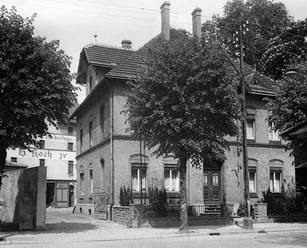



Photo Gallery