Stadtrundgangs - Informationstafel "Dreizehnlinden Brunnen"


The object
The fountain is a gift from the town of Driburgan Caspar Graf von Oeynhausen-Sierstorpff. The then owner of the Gräfliches Bad celebrated his 60th birthday in 1986. His home town took this as an opportunity to honor him for his services and commissioned the artist Werner Klenk from Oelde to design a fountain. This was ceremoniously inaugurated on July 9, 1988.
The epic
"Dreizehnlinden"
The reliefs show motifs from the epic "Dreizehnlinden." It was published in 1878 by Friedrich Wilhelm Weber, who came from Bad Driburg-Alhausen. In the form of 25 songs, it describes the overcoming of paganism by Christianity. The story takes place in the "Nethegau "* - the author's homeland - between spring 822 and summer 823, the reign of Louis the Pious - the successor to Charlemagne. The story is fictitious. Nevertheless, according to Weber, Corvey Monastery can be imagined as "Thirteen Lindens". The work became famous throughout the German-speaking world shortly after its publication.
Political background
The first Imperial Chancellor Otto von Bismarck launched a so-called "Kulturkampf" after the founding of the German Empire. Catholics were declared enemies of the Reich. Catholic ideas, for example, could only be disseminated via hymn books or unsuspicious medieval stories. Thirteen Linden" is another such story: it was commissioned by Catholic literary circles and was intended to hold up a mirror to society. Incidentally, the Christian, reconciliatory epic was compulsory reading at school until the 1950s.
The plot
The pagan Saxon people are subjugated by the Christian Franks. The Saxons hate the victors, but the Christian doctrine gradually finds its way into their hearts. The epic is told through the fate of various characters. The main character of the Saxons is Elmar, the lord of the "Habichtshof". There is also Rab, the Escheburger, as well as the pagans Thiatgrim and Swanahild. The Franks are represented by the Gaugraf Bodo and the royal emissary Gero. There are also the monks of the "Dreizehnlinden" monastery. Another character is Hildegunde, Elmar's chosen one: despite her passive role, she is very influential and embodies neither Christianity nor paganism, but rather general humanity. Other secondary characters also appear, making the epic multifaceted and lively.
Image sources: Unless otherwise indicated, the illustrations come from the archives of the town of Bad Driburg, Meiners, Herzog or Gehle.

Good to know
General information
Parking Available
Bus stop available
Payment methods
- Entrance Free
Directions & Parking facilities
- By car:
Start on the B64 in an easterly direction. After about 1.5 kilometers, turn right onto the K18. Follow the road for around 700 meters, after which it becomes Westenfeldmark (K18). After about 1.4 kilometers, Westenfeldmark turns left and becomes Lange Straße. Another 1.4 kilometers later, Lange Straße turns left again and becomes Pyrmonter Straße. After about 180 meters, turn right onto Konrad-Adenauer-Ring. After around 600 meters, the finish line is on the left-hand side.
By bus:
Travelers from Paderborn can easily reach Bad Driburg with the S30 bus line, which runs every hour. Get off at the bus stop "Bad Driburg, Polizei". From there it is only a short walk of about one minute to your destination.
Nearby


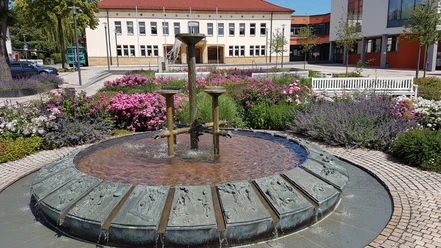

Photo Gallery