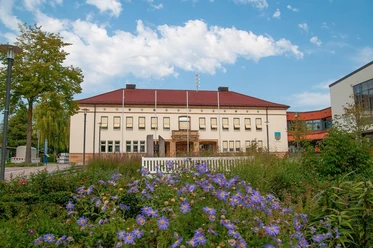
Bad Driburg already has its third town hall. Its construction began in 1939 during the National Socialist era.
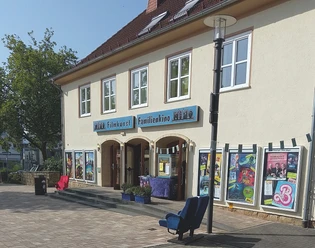
Together with the cinema to the west of it, it was built on an industrial wasteland. The "Friedrichshütte" glassworks, which was once
located on this site, had already been
closed ten years earlier due to the global economic crisis. The town hall and cinema are located "halfway" between the old town and the spa, reflecting the growth of the town from the Middle Ages to the present day. The architecture of both buildings is referred to as "Heimatschutzstil
". This style was intended to represent and reflect the regional traditions
of building and to emphasize the buildings through their simplicity. Decorations and historicizing elements were therefore deliberately avoided. The cinema was completed at the turn of the year 1939/40. The town hall, on the other hand, remained a shell until the end of the war and was not ready for occupation until 1947. A cinema was more important for the dissemination of National Socialist propaganda than an administrative building. In 1975, an extension to the town hall became necessary as part of the municipal reorganization. Construction work was completed in 1978.
Yesterday
The first town hall was located in the middle of today's "Alter Markt", immediately southwest of St. Peter and Paul's Church. It was built as a half-timbered house and completed Driburg's urban development process in the 13th century. It protruded into the
market on Lange Straße like a barrier. Built right in the center of the town, it demonstrated the power of the town authorities over the market. In 1805, the building had to make way for the expansion of Lange Strasse and the market. By this time, it had lost its function of demonstrating municipal power.
The second town hall was built in the Prussian period of the 19th century. Located on the northern
edge of the city center on the old city wall in Schulstraße, the building was originally
built as a poorhouse. The Prussian municipal code tied the local administration closely to the state. This meant that the councillors and the mayor had little freedom to shape their own destiny. It was only after the town walls were demolished towards the end of the 18th century that Driburg began to develop eastwards along Lange Straße towards Bad.
Image sources: Unless otherwise indicated,
the images originate from the archives of the town of Bad Driburg, Meiners, Herzog or Gehle.

General information
Parking Available
Bus stop available
Payment methods
- Entrance Free
Directions & Parking facilities
- By car:
Start on the B64 in an easterly direction. After about 1.5 kilometers, turn right onto the K18. Follow the road for around 700 meters, after which it becomes Westenfeldmark (K18). After about 1.4 kilometers, Westenfeldmark turns left and becomes Lange Straße. Another 1.4 kilometers later, Lange Straße turns left again and becomes Pyrmonter Straße. After about 180 meters, turn right onto Konrad-Adenauer-Ring. After around 600 meters, the finish line is on the left-hand side.
By bus:
Travelers from Paderborn can easily reach Bad Driburg with the S30 bus line, which runs every hour. Get off at the bus stop "Bad Driburg, Polizei". From there it is only a short walk of about one minute to your destination. License (master data)
Madita Claes