For over a thousand years - until 1929 - the water of the Pader was indispensable for the people of Paderborn. Drinking water, service water and, above all, water for firefighting: the constantly flowing springs supplied it in abundance and shaped everyday life in the city.
In the Middle Ages, however, Paderborn was repeatedly ravaged by devastating fires. Half-timbered houses burned quickly - faster than fire-fighting water could be brought in. The fire disaster of 1506 in particular, in which around 300 houses were destroyed, prompted the city council to fundamentally reorganize the fire-fighting water supply.
In 1523, a so-called "Wasserkunst" was built on the Börnepader - a technical masterpiece of its time. A water wheel used the power of the River Pader to "artificially" transport water uphill to higher parts of the city using a piston pump. There it was collected in large stone basins: the Kümpe. From here, the citizens could draw water for extinguishing fires, but also for their daily needs.
From the highest Kump am Kamp, the water was distributed via a system of pipes to other Kümpe - including on the market square, in front of the town hall, on today's Marienplatz and on Westernstraße near the Franciscan monastery. Ecclesiastical institutions even had their own waterworks, such as the Jesuit College (from 1604) and the Capuchin monastery (from 1626).
With the expansion of a modern network of pipes from 1887 and new hygiene requirements - triggered by cholera and typhoid epidemics in the 19th century, among other things - the historical water supply became increasingly less important. In 1929, the Sennewasserwerk finally replaced the old waterworks.
Today, the redesigned Kümpe fountains are a reminder of this special phase in the city's history - visible signs of how innovation and necessity have shaped Paderborn.
Preserved Kümpe in the city centre
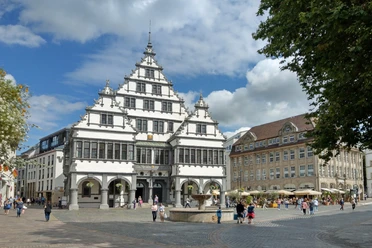
Rathauskump
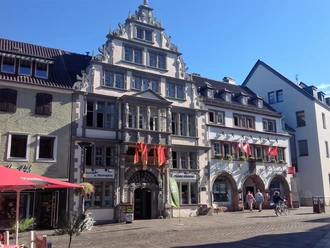
Located directly in front of the historic town hall, the Rathauskump has marked a central point of city life for centuries. In the past, it was used to supply water to the surrounding buildings and markets, today it is a prominent landmark and popular meeting place.
Liborikump
The highest situated kump on the Kamp was the first collection point for pumped water. From here, it was distributed further into the city
Kump Franziskanerkirche
Situated in a somewhat quieter location, it is a reminder of the extension of the historical supply network to the western areas of the city.
Payment methods
- no entrance possible