Johanniskirche


Please note: Opening hours may vary during events in and around the church!
History
St. Johannis is actually the parish church of Herford Neustadt, which was founded in 1220. The Gothic hall church was built between 1240 and 1310.
In 1414, St. Dionys Abbey was moved from Enger to the fortified town of Herford due to its insecure location; the collegiate church became St. John's Church. The canons brought with them not only the famous Dionysius Treasure with Charlemagne's tasks to Widukind, but also the (supposed) bones of the Saxon Duke Widukind, which rested in St. John's Church until 1810. In 1532, in the course of the "Herford iconoclasm" during the Reformation, numerous works of art and furnishings in the monastery and church were destroyed. The monastery itself continued to exist as a Protestant institution until secularization in 1810. Today, the Dionysius treasure is in the Berlin Museum of Decorative Arts and the bones are back in Enger. After the building fell into considerable disrepair in the 19th century, the tower had to be demolished down to its foundations and completely rebuilt between 1906 and 1910. The construction of a municipal sewage system had led to a rapid drop in the groundwater level.
The tower had to be rebuilt from 1906 - 10. It is now 71 m high
Typical pointed arches can already be found at the entrance door
St. Johannis is home to the "Open Church"
The Steinmann organ was installed in 1955
Because the Johanniskirche, like all historical buildings in Herford, was founded on oak piles, these began to rot and lose their stability. Although the new tower from 1906 to 1910 was built using the old materials and in the old form, it was one storey shorter (7 m) than its predecessor. It now has a height of 71 m and is therefore still the tallest church tower in Herford.
Windows
The stained glass windows, which are among the oldest in Westphalia, date back to the 14th and 15th centuries. They were saved from destruction in May 1940 thanks to the courageous efforts of the then parish priest Helmut Gaffron.
Furnishings
The artistically valuable interior dates largely from the 16th and 17th centuries. The wooden carved official chairs of the craftsmen's guilds of the new town are characteristic. The baroque pulpit was donated by Mayor Daniel Pöppelmann, a direct ancestor of Matthäus Daniel Pöppelmann, the builder of the Dresden Zwinger, who was born in Herford in 1662.Today
St. Johanniskirche is home to the "Open Church". In addition to the 6 p.m. church service in the summer months, selected events and special art exhibitions take place here. It is therefore a lively part of Herford's cultural work. And even though St. Johannis is no longer heated in winter for cost reasons, you can experience a very special Christmas Eve service here, snuggled up in a warm blanket in the full glow of lights for a very original Christmas night.
Maintenance
The maintenance and upkeep of St. Johannis Church and our two other inner city churches is a (costly) undertaking. Part of the necessary funds are provided by the Friends' Association. Any support is welcome here.
Good to know
Openings
Eligibility
Suitable for any weather
for Groups
for Class
for families
for individual guests
Pet allowed
Suitable for the Elderly
for Children of all Ages
Suitable for Pushchair
Other Furnishing/Equipment
cool place
Payment methods
- Entrance Free
Directions & Parking facilities
- New Market 1
32052 Herford
Nearby
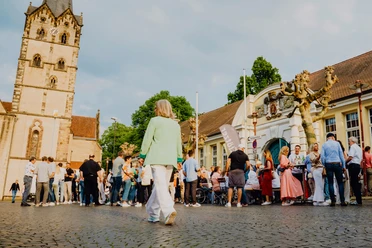






Photo Gallery