Liborius was Bishop of Le Mans in what was then Gaul (modern-day France) and a contemporary of St. Martin of Tours. After a long life as a pastor and founder of the faith, he died around the year 397. His relics - his bones - were solemnly brought from Le Mans to Paderborn in 836 AD to strengthen the young church in the East. Since then, he has been considered the patron saint of the city and the diocese.
In 836, Bishop Badurad of Paderborn received the relics of the saint from Le Mans. The transfer of the relics was more than just an ecclesiastical act - it established the "covenant of eternal brotherhood" between the churches of Paderborn and Le Mans, one of the oldest city partnerships in the world.
Since July 23, 836, this event has been celebrated every year with the nine-day Liborifest - today one of the largest public festivals in Westphalia.
The peacock is still associated with St. Liborius to this day. According to legend, a peacock flew ahead of the legation from Le Mans to Paderborn when his relics were transferred in 836. When it arrived in Paderborn, it sat down on the cathedral and fell down dead - as a sign that its mission had been fulfilled. Since then, the peacock has been regarded as an attribute of the saint and visitors have repeatedly encountered it in depictions, during processions and in the cityscape as a symbolic sign of recognition.
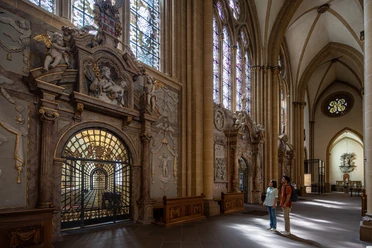
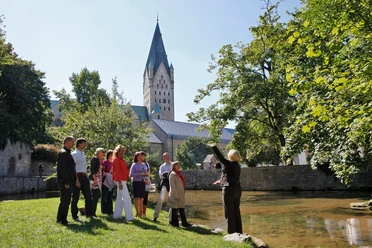
The remains of the saint are still kept in the precious shrine, which is located in the crypt of the Cathedral of St. Mary, St. Liborius and St. Peter. Maria, St. Liborius and St. Kilian in the center of Paderborn
The relics of St. Liborius are kept in the Hoher Cathedral of St. Maria, St. Liborius and St. Kilian - but not permanently in the well-known large shrine. They are kept in a small ebony box in the altar of the crypt.
The relics of St. Liborius are only transferred to the large gilded silver shrine for the annual Libori celebrations. Its solemn elevation and exposure behind the high altar in the High Cathedral of St. Mary, St. Liborius and St. Kilian forms the impressive start to the Libori festival year after year. Another highlight is the subsequent procession: accompanied by clergy, associations, music groups and numerous believers, the shrine is carried through the city. In this way, spiritual ritual and urban identity are combined - visibly lived tradition and community, which characterize Libori to this day.
Openings
Payment methods
- Entrance Free