Stadtrundgangs - Informationstafel "Mühlenpforte"


Town gates
Driburg was a well-fortified town in the Middle Ages. Access was essentially only possible via three city gates. Customs had to be paid there. Not far from this point was the eastern gate, popularly known as the "Niederntor". South of the gate, pedestrians could also enter the town through the small mill gate. This was the site of one of a total of eight mills that ground grain in and around Driburg. It was in operation from the Middle Ages until 1937
and thus made an important contribution to supplying the population with flour. The mill was under the control of the Bishop of Paderborn, the sovereign at the time. It had to be approached first by farmers who wanted to get rid of grain. Only when it was at full capacity were the farmers allowed to take their grain to another mill. From the 19th century, this advantage was abolished by the freedom of trade. Competition from ever larger mill companies
made it increasingly difficult to operate the mill economically. Eventually, the business was closed down completely. In the course of urban redevelopment in the 1970s, the miller's house and the mill
along with the mill wheel were removed. In 1984, the square was redesigned and part of the historic town wall was reconstructed.
Town wall
Driburg was one of the so-called fortified small towns when it was founded and had fewer than 1000 inhabitants in the Middle Ages. The small country town was characterized by agriculture and the typical half-timbered houses of the farming community. Gradually, glass production and the glass trade developed in Driburg. The Westphalian Hellweg, a historic trade route between Duisburg and Höxter/Corvey, was also a key factor in the town's economic upturn. Driburg's town wall was first mentioned in a document in 1290. It was once over two meters high and served primarily as a fortification
and to protect the population and the market. Goods were transhipped here on their way between the neighboring towns of Steinheim, Warburg, Beverungen, Höxter, Paderborn and beyond.
It was only around 1800 that the town outgrew its historical "corset" after the town wall fell into disrepair and was demolished.
Image sources: Unless otherwise indicated,
the images originate from the archives of the town of Bad Driburg, Meiners, Herzog or Gehle.

Good to know
General information
Parking Available
Bus stop available
Payment methods
- Entrance Free
Directions & Parking facilities
- By car:
Dringenberger Straße is easily accessible via Pyrmonter Straße (B64). There are plenty of parking spaces in the immediate vicinity of the mill wheel, so you can easily park your car. This guarantees a stress-free journey.
By bus:
The Bad Driburg community bus stops in the town center at the "Marktplatz" stop, which is only about a 5-minute walk from the mill wheel. The central location of the bus stop makes it easy to reach the mill wheel and enjoy the flair of the town at the same time.
Nearby
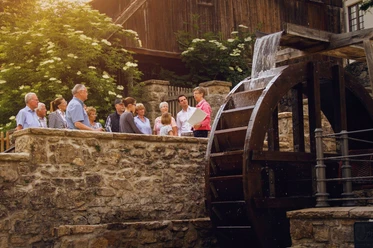


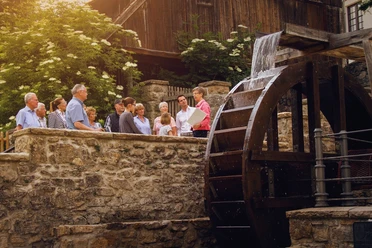



Photo Gallery