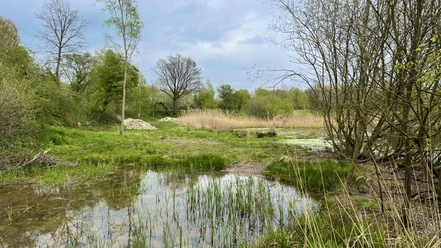
Reedbeds of various types can be found on the shallow banks of slow-flowing rivers and still waters. The plants are adapted to the amphibious conditions with regularly changing water levels and usually form dense stands.
Due to the good water and nutrient supply, they are also very vigorous. Reed (Phragmites australis), for example, can reach heights of up to four meters. Cattail (Typha latifolia) also reaches similar heights. It spreads by means of small, light fruits that are spread over long distances by the wind or water and thus colonize new habitats. Once a plant has gained a foothold, it spreads in the immediate vicinity mainly by underground runners, which in the case of reeds can reach lengths of up to 20 meters. Stands of reeds and bulrushes are often established by a single plant! In the case of reeds, these can become very old, as studies in the Danube delta have shown: There, the age of the plants studied was estimated at around 8000 years.
Good to know
Payment methods
Entrance Free
License (master data)
Frank Grawe Landschaftsstation im Kreis Höxter e.V.