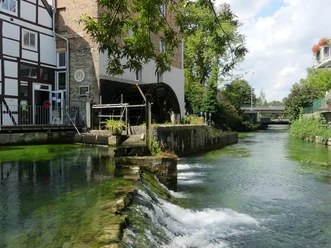
The Pader springs are among the strongest in Germany. They give rise to an extraordinary river: After just 4.6 kilometers, the independent Pader already ends in Schloß Neuhaus, where it flows into the Lippe coming from Bad Lippspringe. This makes the Pader the shortest river in Germany.
From here, the water continues its journey: via the Lippe, it flows through north-west Germany to the Rhine and finally into the North Sea. Over the centuries, the Pader has been reshaped several times. Its straightening at the end of the Middle Ages was particularly influential in order to regulate the water level and improve its use as a traffic and transport route.
The Pader is therefore not just a natural phenomenon, but a formative piece of the city's history and identity.
The sources of the Pader
In the center of Paderborn, the Pader rises from over 200 individual springs. An impressive 5,000 liters of water per second flow to the surface from two large spring areas - a unique natural spectacle and the basis for the shortest river in Germany.
The cause lies in the special geological conditions of the region: rainwater seeps into the limestone layers of the surrounding plateau and collects under an impermeable layer of rock. Along natural fault lines, it is finally forced back to the surface at the edge of the terrain towards the city center - this is where the powerful Pader springs are created.
The water moves surprisingly quickly underground and can emerge again after just a few days. This creates a lively spring area in the heart of the city, which has been a natural habitat, lifeline and landmark at the same time for centuries.
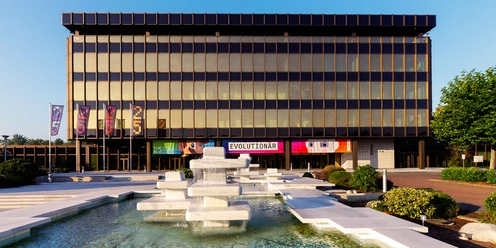
The names of the Pader springs have different origins and are derived from their location, their characteristics and their historical function. Some of the names have changed over the centuries. It was not until 1967 that the city of Paderborn made an official regulation that established the names that are valid today. According to this regulation, the headwaters of the eastern headwaters are called Dielenpader and Rothobornpader, while those of the western headwaters are called Börnepader, Dammpader and Warme Pader. The Maspernpader, which is located near the PaderHalle, is the outflow of the middle spring area. This results in a total of six spring streams, which are named as follows from east to west: Dielenpader, Rothobornpader, Börnepader, Dammpader, Warme Pader and Maspernpader.
Payment methods
- Entrance Free