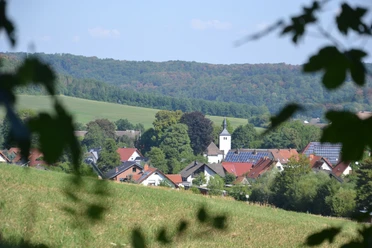
Pömbsen - A village with over a thousand years of history
Pömbsen and the church were first mentioned in the chronicles of Bishop Meinwerk in 1015. The village was founded in 875 by a Roman named Pumi, who settled roughly where the water treading basin is located today. Although the village with its 500 to 600 inhabitants is one of the small districts of Bad Driburg, the large parish of Pömbsen has an important function and is considered one of the oldest in the region. Pömbsen is a place of pilgrimage to the Holy Cross. Here, the old custom of the costume of the cross is still practiced, i.e. on Good Friday, the Passion of Christ is depicted in a procession.
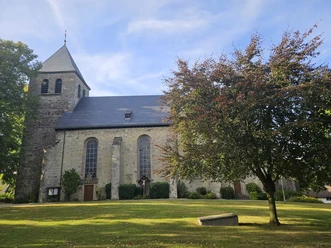
The first church in Pömbsen was built in the year 1000. Today's Church of the Assumption of the Virgin Mary is the third reconstruction, the foundation stone of which was uncovered in 1935. Pömbsen is a place of pilgrimage to the Holy Cross. The more than 400-year-old St. Mark's lime tree on the road to Alhausen forms the starting point of the stone Way of the Cross, which leads uphill to St. John's Chapel (Kluskapelle). The 14 reliefs of the Stations of the Cross originally date back to 1748, but have been renewed time and again. The carrying of the cross on Good Friday has been a tradition in Pömbsen for over 250 years. The annual Stations of the Cross procession through the village begins with the departure of the group of crosses from the parish church of the Assumption of Mary.
For the poets Friedrich Wilhelm Weber, Augustin Wibbelt and Peter Hille, Pöbmsen was partly home or inspiration. On Bilster Berg, north of Pömbsen, there is a modern test and presentation track in an abandoned NATO ammunition depot, which is used by the car industry, among others.
A hiking information point is located at this point:
Hiking information points with selected hiking tour tips and descriptions of the surrounding sights have been set up in all Bad Driburg districts. These boards also serve as starting points for the listed hiking tours.