


- 1:00 h
- 4.35 km
- 46 m
- 46 m
- 202 m
- 227 m
- 25 m
- Start: Pavilion at the level crossing
This approx. 1-hour city tour through Bad Driburg takes you to the following destinations:
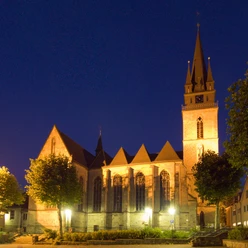
- Protestant church -
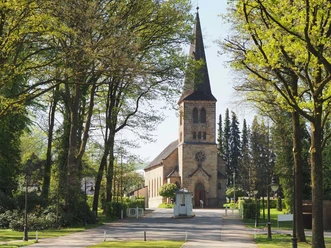
At the end of the main axis of the Count's Park is the Protestant church, which was consecrated in 1854. For the Protestants in the predominantly Catholic Driburg, it was a stroke of luck that the owner of the spa, Ernst Graf von Sierstorpff, was married to Caroline Freiin von Vincke, the daughter of the Protestant Chief President of Westphalia. She hired the assistant preacher Brachmann, who held his first service in the count's chapel at the fountain in 1850. Brachmann bought a plot of land with a small house opposite the spa gardens, which served as a vicarage with a schoolroom. The foundation stone of the Protestant church was laid on this plot in 1853. The church, a simple elongated sandstone building, initially without a sacristy and tower, was repeatedly extended. In 1889, it was given a tower with three bronze bells. A new Fischer & Krämer organ was inaugurated in 1991 thanks to the founding of an organ-building association. Today, the friendly-looking little church is the oldest existing church building in Bad Driburg.
- Count's Park Bad Driburg -
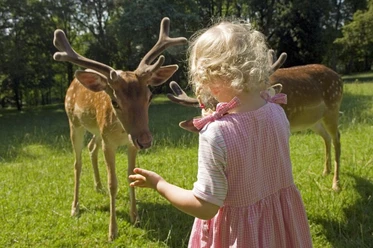
Contemporary garden art and the charm of the Wilhelminian era are combined in the 65-hectare, multi-award-winning park. Manicured lawns, flowerbeds that change throughout the year and rare tree plantings such as ancient live oaks, exotic ginkgo and maple trees characterize the picture. The large park pond with bridges and the "Diotima" island, which lies opposite the Hölderlin grove, is charming. Also worth seeing is the 7.5-hectare game reserve with around 50 animals, which is integrated into the Gräflicher Park via a "HaHa moat". During summer events, the enclosure is transformed into a forest stage worth seeing. In the summer of 2009, the only publicly accessible Piet Oudolf garden in Germany was opened in Gräflicher Park as part of the Ostwestfalen-Lippe Garden Landscape. It is a year-round flowering garden of several hundred different plants, which can be experienced as a park within a park and as a small piece of wilderness with its curved beds, lawn islands and narrow paths.
- Glass museum -
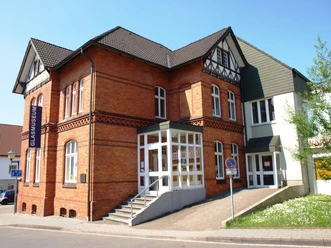
The Bad Driburg Glass Museum in the Heinz Koch House was founded to reflect the centuries-old glassmaking tradition of Bad Driburg. It reflects the history of the glass town of Bad Driburg: one part of the museum shows how glass was made in the Bad Driburg glassworks and how the glassmakers lived and worked in Bad Driburg. The experiences of the glassmakers are reflected in a collage of tools, narrative documents and pictures. At the center of the museum is a glassmakers' workbench, around which the work and everyday life of the glassmakers revolved.
- Parish church of St. Peter and Paul -
The impressive Catholic parish church of St. Peter and Paul was built between 1894 and 1897 according to plans by Arnold Güldenpfennig and dominates the skyline of Bad Driburg. The interior of the three-aisled neo-Gothic hall church with transept still has the complete furnishings with pulpit, organ, altars and (partial) glazing from the time of construction.
The church was painted in 1909 in the Baroque Art Nouveau style. The Romanesque baptismal font (around 1260), two baroque figures of the patron saints from 1676 and the gravestone of the canon Heinrich von Driburg, who died in 1463, are still preserved from the furnishings of the previous church.
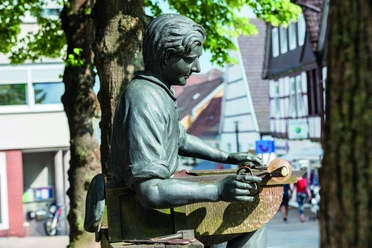
- Monument to the glassmakers -
Few crafts are more captivating to viewers than the art of glassmaking: the glowing, fizzing and steaming, the distorting with tongs and other tools, the coloring with powders and crystals and, last but not least, the luminous glass mass itself exert a special fascination. However, there is no craft that is more strenuous than glassmaking: every glassmaker who goes about his work, takes his glass mass out of the glowing hot furnace hole and forces it into the desired shape, also knows about the hardness of the art. To commemorate the glassmakers who worked in Bad Driburg for centuries, the "Förderverein Glasstadt Bad Driburg" erected the glassmakers' memorial in the upper Lange Straße in 2006.
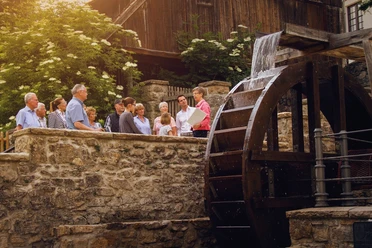
- Mill wheel -
The Mühlenpforte is a place of tranquillity in the middle of the city center. One of the town's seven mills, the "Piepsmühle" or "Heckersche Mühle", named after its former owners, was located here on the Kesselbach stream outside the town wall at the Lower Gate. It was one of the oldest mills in Bad Driburg and ceased operation in 1937. The mill and residential building disappeared as part of the redevelopment of the town center in the 1970s. The mill wheel erected by the town of Bad Driburg in 1984 is integrated into the reconstruction of a section of the medieval town wall and is a reminder of the former mill.
- Raiffeisen fountain -
The modern Raiffeisen fountain in front of the Volksbank in Lange Straße is a gift from the former savings and loan association to the town of Bad Driburg to mark the 700th anniversary of the town in 1990 and the 100th anniversary of Friedrich Wilhelm Raiffeisen's death. The fountain sculpture by sculptor Jonas Müller is dedicated to the theme of "movement and progress". The column consists of three parts, which are subdivided by marble slices. These marble disks, which represent coins, are carried by goddesses. They symbolize Raiffeisen's cooperative idea: many bear a - financial - burden together and thus become strong. The transience of man and his material goods is symbolized by a skull, a broken water jug and small coins running through the hands of the figures.
- Glass merchant plaque -
The economic development of Bad Driburg and other parts of the Eggegebirge is not only closely linked to glass production, but above all to the glass trade. With the establishment of the first glassworks, several glass merchants settled in Bad Driburg in the 15th century. By 1900, the Bad Driburg Trade Association had already united more than 100 glass trading companies. The glass goods produced were initially transported by panniers, then by goat, donkey and dog carts and later by covered horse-drawn carts on journeys lasting months throughout Europe. The trade routes of the Bad Driburg glass merchants already stretched from Denmark to Bavaria and from the Benelux countries as far as Russia. With the local companies glaskoch (LEONARDO Glas), Ritzenhoff&Breker (Flirt by R&B) and Walther Glas, Bad Driburg is still one of the most important glass production and trading centers in Europe: Bad Driburg glass is exported all over the world. Visit the copper decoration plaque in the town center created by the "Glasstadt Bad Driburg" association to commemorate the Bad Driburg glass trade or take a tour of the town to learn about the history of the glass trade.
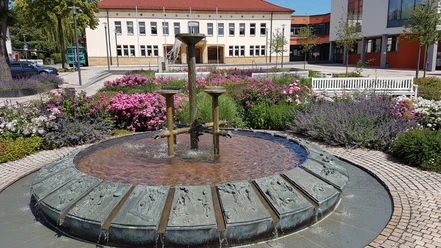
- Thirteen Linden Fountain -
The Thirteen Linden Fountain on the town hall square is an artistic representation of the overcoming of paganism by Christianity, based on the epic "Thirteen Lindens" by Friedrich Wilhelm Weber.
The Thirteen Linden Fountain is a work by the freelance artist Werner Klenk from 1988. It is fed by nine water sources. Two plants entwine at the intersection of the water columns: the water lily as a Saxon tribal symbol of the Engern people, who lived near Driburg, and the iris or lily as a symbol of the Franks. The 25 reliefs attached to the fountain surround show motifs from the epic "Dreizehnlinden".
Best to visit
- suitableDepends on weather
Directions
- From the pavilion at the level crossing along the Gräflicher Park > at the outdoor pool on the far left into the Gräflicher Park > past the game enclosure to the Brunnenarkaden > turn left there and behind the guest service center turn right to the Piet Oudorf Garten > there turn right past the labyrinth > at the end turn left onto Gräfin-Margarete-Allee > follow the avenue over the level crossing and past the halls of the Bad Driburger Naturparkquellen > at the end of the avenue turn left > cross the Konrad-Adenauer-Ring > straight ahead onto Freiheit > turn left into Schulstraße > behind the Glasmuseum turn right > cross Prälat-Zimmermann-Straße > at Pyrmonter Straße turn left onto Lange Straße > past the parish church of St. Peter and Paul and the Glasmacherdenkmal to the Saabel bookshop > there turn right into Mariengässchen > down the stairs and at the Mühlrad turn left onto Dringenberger Straße, then right into the pedestrian zone (Lange Straße) > on Lange Straße back to the Tourist Information
Tour information
Familiy-Friendly
Loop Road
Stop at an Inn
Directions & Parking facilities
- Getting thereComing from the B 64 from Paderborn, take the Bad Driburg - Kurgebiet exit and follow Brakeler Straße until you cross the level crossing.ParkingParking spaces directly at the pavilion at the railroad crossingPublic transportationBad Driburg has its own train station and is integrated into the existing hourly timetable of Deutsche Bahn and NordWestBahn. The pavilion at the level crossing is just a few minutes' walk from the station.
Additional information
- Further information about the Bad Driburg moor and mineral spa in the
Naturpark Teutoburger Wald / Eggegebirge can be obtained from Bad
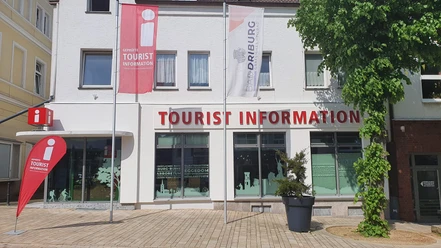
Driburger Touristik GmbH - Tourist Information Literature
- Bad Driburg - Count's private spa in the Teutoburg Forest / Eggegebirge Nature Park (2009), BAD DRIBURGER TOURISTIK GMBH, Jörg Mitzkat publishing house ISBN: 978-3-940751-19-5
License (master data)
Bad Driburger Touristik GmbH

Map
- Bad Driburg city map with hiking and cycling map, 1:20,000
available from Bad Driburger Touristik GmbH - Tourist Information


