Römerlager Anreppen

Historic site
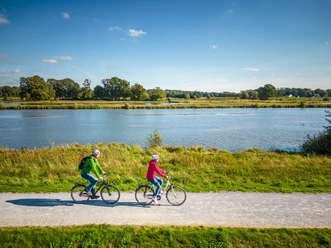
The Anreppen Roman camp was only discovered in 1968. Thanks to the excavations carried out over decades by the Westphalian Museum of Archaeology, the Anreppen Roman camp is now one of the most important early Roman monuments in Germany. The 23-hectare camp is located directly on what is now the south bank of the River Lippe and had the shape of an irregular, elongated oval. Sections of two Roman traffic routes were found around 500 m and 700 m east of the camp respectively.
2000 years ago, Rome waged war against the Germanic tribes (12 BC - 16 AD). Concrete war aims have not survived. On the other hand, ancient historians provide us with many details about the course of the war, the internal conditions in Germania and the people involved on the Germanic side (including Arminius).
Four main phases can be identified in this war: the campaigns of Drusus (12 - 9 BC), the campaigns of Vinicius and Tiberius (1 - 5 AD), those of Varus (7 - 9 AD) and, in response to the disastrous Varus Battle, the revenge campaigns of Germanicus (14 - 16 AD). In the year 16, the fighting was stopped by order of Emperor Tiberius.
In the course of the war, Roman military camps were built along the Lippe: in Dorsten-Holsterhausen, in Haltern am See, in Bergkamen-Oberaden and in Delbrück-Anreppen. These camps were built and cleared at different times. They are so-called wood-earth camps. All of the structures were built as half-timbered or purely wooden constructions without the use of stone.
The Roman camp at Anreppen was only built after the turn of the century. The Roman historian Velleius Paterculus (II, 105) reports the construction of a winter camp on the upper reaches of the Lippe in the year 4. Several timbers from a crew latrine and a well dating back to the year Chr. match this. Prior to this, there was a somewhat older military installation, as a Roman defensive ditch was excavated in the eastern part of the camp. The end date of the Anreppen Roman camp is less clear. According to the latest findings, the camp was cleared shortly after the end of Tiberius' campaigns. Of the approximately 400 coins found in the camp, not a single one can be linked to the governorship of Varus. At the time of the Varus Battle in the year 9, the proverbial grass had already been growing over the ruins of the Anreppen Roman camp for around three years.
In the course of the excavations, around a third of the camp area was scientifically investigated. In particular, the floor plans of the commander's building (praetorium) with neighboring gardens and representative residential buildings were uncovered. In addition, the camp baths with several renovated ovens, several crew quarters on the southern front of the camp and near the via praetoria, the southern and eastern camp gates and several grain and material stores were also discovered.
The architectural design of the commander's building, which had palatial dimensions (approx. 47.5 m x 71 m), is of outstanding importance. For a normal commander, such a magnificent building would have been completely oversized, but not for the commander-in-chief Tiberius, who was now officially regarded as the future successor to Emperor Augustus.
Unique among the Roman camps in Westphalia is also the military bath measuring approx. 23.5 m x 42 m. Here, the soldiers were given a simple bath. Here the soldiers were offered the usual bathing procedure in a simple way. The bathers first entered the cold bath (frigidarium), then went into the warm bath (tepidarium) to warm up and then proceeded to the hottest room, the hot bath (caldarium). The Anreppen military baths functioned primarily as a hygienic facility, not as a place of pleasure.
The number of storage buildings is also a special feature. The warehouses were located near the south and east gates. Directly at the south gate was a huge 56 m x 68 m granary. At the east gate, on the other hand, a veritable warehouse town was created, in which several grain and material stores were separated from the rest of the storage area by a wooden palisade. Due to this unique accumulation of warehouses, which far exceeded the camp crew's own requirements, the Anreppen camp must have had another function in addition to its role as a troop camp: the task of a logistical base from which the troops fighting far to the east of Germania were supplied.
Numerous finds were discovered during the excavations at the Anreppen Roman camp, which primarily ended up in the ground as waste. The finds are everyday objects used by the soldiers, mainly broken ceramic crockery. The finds also include storage and cooking vessels, metal objects such as tools, nails and pieces of weaponry. The representative finds are on display in the LWL Roman Museum in Haltern am See.

Roman camp Anreppen - bringing history to life
Until now, only a few things were recognizable at the Roman camp: a street name "Am Römerlager", a few signposts and an information pavilion. Apart from that, the layman saw nothing on the site that he could directly associate with this important archaeological monument.
A number of initiators want to make the historicity of the site more obvious to local residents and visitors from outside and at the same time highlight the significance of this important monument for Westphalian regional history. The concept initially envisages the following measures: the restoration of the storage trenches, the construction of a road area, the erection of a centurion house and the realization of an archaeological nature trail.
The ground-breaking ceremony for the construction of the Anreppen Roman Park took place in July 2008. The start was made with the Roman defensive ditches in the immediate vicinity of the south gate. The 7.5 m wide main ditch and the 4.5 m wide preliminary ditch are now visible again in their original form over a length of 75 meters. Visitors can see the impressive defensive effect of this mighty obstacle at a glance. The storage trenches were not filled with water; water only stood in the top of the trench when the groundwater level was high.
In May 2009, work began on restoring a road quadrangle. Construction of the roads has now been completed. The total road area amounts to 3600 m². The central zone of the via principalis with a width of 12 m (total width originally 36 m), the road leading through the south gate to the outside, the via decumana dextra with a width of 9 m over a length of approx. 185 m, a 9 m wide road branching off from it, which once ran between the staff building and the commander's palace, and a section of the via quintana, also 9 m wide, were laid out over a length of approx. 100 m. The enormous dimensions of the Roman camp roads become particularly apparent when compared with the asphalt road running directly next to it.
Within this street quadrangle (insula) there were once several barracks and seven houses intended for officers. These officers were centurions, each of whom commanded one hundred men. It is planned to reconstruct one of these centurions' houses in the foreseeable future, taking into account the scientific principles still to be developed, provided that the project can be financed by public funds and sponsorship.
Furthermore, the conceptual work for the realization of an archaeological educational trail has been commissioned. This information system is intended to provide visitors with the history of Anreppen in Roman times and offer insights into Roman camp life.
On request, group tours of the Roman camp site can be conducted by the Anreppen local history association. These can be booked by prior appointment via the Heimatverein Anreppen, Mr. Hubert Lenzmeier, Holzweg 8, 33129 Delbrück-Anreppen, phone 05250/8828 or email hubert.lenzmeier@anreppen.de.

Text: Dr. Johann-Sebastian Kühlborn, retired chief curator
Email: ateius@gmx.de


Literature to get you started: Johann-Sebastian Kühlborn, Anreppen, Stadt Delbrück, Kreis Paderborn. Roman camps in Westphalia 4 (Münster 2009).


Good to know

Eligibility

  • Pet allowed

Payment methods

Entrance Free

Directions & Parking facilities

The Roman camp is located south of Delbrück-Anreppen on Bentfelder Straße.

Nearby

Contact

Römerlager Anreppen
Am Römerlager
33129 Delbrück
© Teutoburger Wald Tourismus / P. Koetters

Photo Gallery