This was an obvious choice, as the fountain named after the sculptor Manzel stood in front of the magnificent new building of the Minden district government on the Weserglacis. The mocking name of the bathing government councillor can be understood as an allusion to the cumbersome and labour-intensive work of the authorities or as an allusion to the status of senior employees who could not manage without "water carriers".
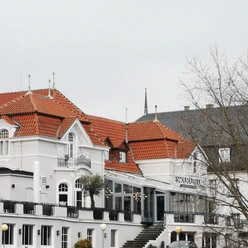
In 1906, a new building with an elaborate interior and exterior design was built between the glacis and Klausenwall for the Prussian district government, which had previously had its increasingly cramped headquarters at the Großer Domhof. With the construction of the government building the area of the Weserglacis formerly located in front of the city wall was also to be remodelled. This included the fountain with the group of figures.
The new construction of the district government including the outbuildings, the procurement of the furniture and the design of the Weserglacis including the fountain cost 1,253,200 marks.The design of the fountain was by the Berlin sculptor Karl Ludwig Manzel, who received a fee of 30,000 marks for this work.
The three male figures "in heroic nudity" are warriors who are only recognisable as such by their helmets and swords. One warrior protectively carries his wounded comrade. A third draws water at their feet for the 'wounded man from the well basin.
"The healing power of water" can be interpreted in different ways. "Superficially, it shows camaraderie and mutual assistance", according to the art historians Ulrike Faber-Hermann and Monika Meier, who have intensively studied Minden architecture around 1900.
They emphasise the relationship of the fountain sculpture to the government building, which is also interpreted by this work of art: In this context, the fountain was intended to express bravery and a heroic "loyalty to the fatherland" and to establish this "permanently" across the eras. This is why the three "warriors" cannot be assigned to a specific time by clothing or armament .
This historical staging also makes the Manzel fountain fit in with the overall artwork of the government building. The magnificent installation, designed by architect Professor Paul Kanold, was intended to document the power and self-confidence of the state. The construction in the Weser Renaissance style created a symbolic bridge between the heyday of the 16th century and the economic power of the Wilhelmine Empire.
In 1906, a new building with an elaborate interior and exterior design was built between the glacis and Klausenwall for the Prussian district government, which had previously had its increasingly cramped headquarters at the Großer Domhof. With the construction of the government building the area of the Weserglacis formerly located in front of the city wall was also to be remodelled. This included the fountain with the group of figures.
The new construction of the district government including the outbuildings, the procurement of the furniture and the design of the Weserglacis including the fountain cost 1,253,200 marks.The design of the fountain was by the Berlin sculptor Karl Ludwig Manzel, who received a fee of 30,000 marks for this work.
The three male figures "in heroic nudity" are warriors who are only recognisable as such by their helmets and swords. One warrior protectively carries his wounded comrade. A third draws water at their feet for the 'wounded man from the well basin.
"The healing power of water" can be interpreted in different ways. "Superficially, it shows camaraderie and mutual assistance", according to the art historians Ulrike Faber-Hermann and Monika Meier, who have intensively studied Minden architecture around 1900.
They emphasise the relationship of the fountain sculpture to the government building, which is also interpreted by this work of art: In this context, the fountain was intended to express bravery and a heroic "loyalty to the fatherland" and to establish this "permanently" across the eras. This is why the three "warriors" cannot be assigned to a specific time by clothing or armament .
This historical staging also makes the Manzel fountain fit in with the overall artwork of the government building. The magnificent installation, designed by architect Professor Paul Kanold, was intended to document the power and self-confidence of the state. The construction in the Weser Renaissance style created a symbolic bridge between the heyday of the 16th century and the economic power of the Wilhelmine Empire.
Eligibility
Suitable for any weather
for Groups
for Class
for families
for individual guests
Suitable for the Elderly
Payment methods
- Entrance Free
Directions & Parking facilities
- The Manzelbrunnen is located at the Alte Regierung in Minden. Parking is available in the street "Weserglacis".